
Seasonality in Trading
Trading Has Seasons, And So Do Traders
If you’ve traded long enough, you’ve probably felt it: the market has seasons.
There are stretches when price action feels clean. Breakouts follow through. Pullbacks make sense. Your setups seem easier to recognize and execute.
Then there are periods when nothing seems to behave the way you expect. Breakouts fail. Intraday action becomes rotational. Moves happen overnight instead of during your normal trading window. Suddenly, even experienced traders can find themselves wondering: Is it me, or has the market changed?
That question is not new to me, but I’ve never really dug into it thoroughly before. So, this fall it sent me hunting into market seasonality for this episode of the Market Mamas Trader Psychology Podcast. And while the historical data was interesting and I get deep into the stats in my episode above, my biggest secondary takeaway wasn't a particular month or percentage.
It was this: Seasonality gives us context, not certainty. And that lesson applies just as much to our development as traders as it does to the markets themselves.
What Market Seasonality Can, and Cannot, Tell Us
Market seasonality looks at recurring historical tendencies across different times of the year. For example, September has historically been a weaker month for the S&P 500, while the final months of the year have tended to be stronger. The Nasdaq has shown its own seasonal tendencies, while gold and crude oil operate with different rhythms influenced by factors such as interest rates, inflation expectations, energy demand, geopolitics and supply conditions.
But none of that means September has to sell off. December doesn't owe traders a Santa Claus rally. And a historically strong month for gold doesn't mean you blindly buy gold. Seasonality isn't a setup. It's environmental context.
For us day traders especially, there is another important distinction: monthly direction and intraday trade quality are not the same thing. A market can finish a month substantially higher while producing plenty of frustrating, two-sided, fake-out-ridden price action along the way. We’ve all seen and likely had to trade through that, so you know what I am talking about! A bullish monthly candle doesn't guarantee clean long setups every morning at the New York open. That's why the goal isn't to predict the next move from the calendar. It's to understand the larger environment while continuing to trade the price action actually in front of you.
Zoom Out Before You Decide Something Is Wrong
One of the oldest pieces of trading advice is to zoom out and look left when price action isn't making sense. We usually apply that to charts. But we can apply it to time as well.
Instead of only studying the one-, three- or five-minute chart, consider where your market sits on the daily, weekly and monthly timeframes. What larger levels are in play? What catalysts are influencing the market? Does your current strategy actually fit the environment you're trading?
And then take that same zoomed-out perspective and turn it toward yourself. Because… traders have seasons too.
The Harvesting Season
Sometimes trading clicks. You're recognizing your setups. Your executions feel clean. You're following your rules, confidence is building and you're getting paid. You're harvesting.
These seasons are incredible! Literally my favorite for sure. But they're also when humility matters. Protect what's working. Don't assume a winning streak means risk management suddenly matters less. Keep doing the boring things that helped create the results in the first place.
The Growing Season
Other times, you're putting in enormous amounts of work without seeing the financial results you want yet. You're collecting screenshots. Journaling. Watching setups. Studying your executions. Missing trades and learning from the FOMO. Making mistakes, reviewing them and trying again.
That doesn't mean nothing is happening. You're growing! Trading development isn't always immediately visible in your P&L. Sometimes the evidence shows up first in smaller losses, better decisions, improved emotional control or your ability to walk away from a trade you shouldn't take. This season is so freaking powerful for the next phases in a trader’s journey. I have had so much more peace with my years in trading when I choose to love and respect these times as well.
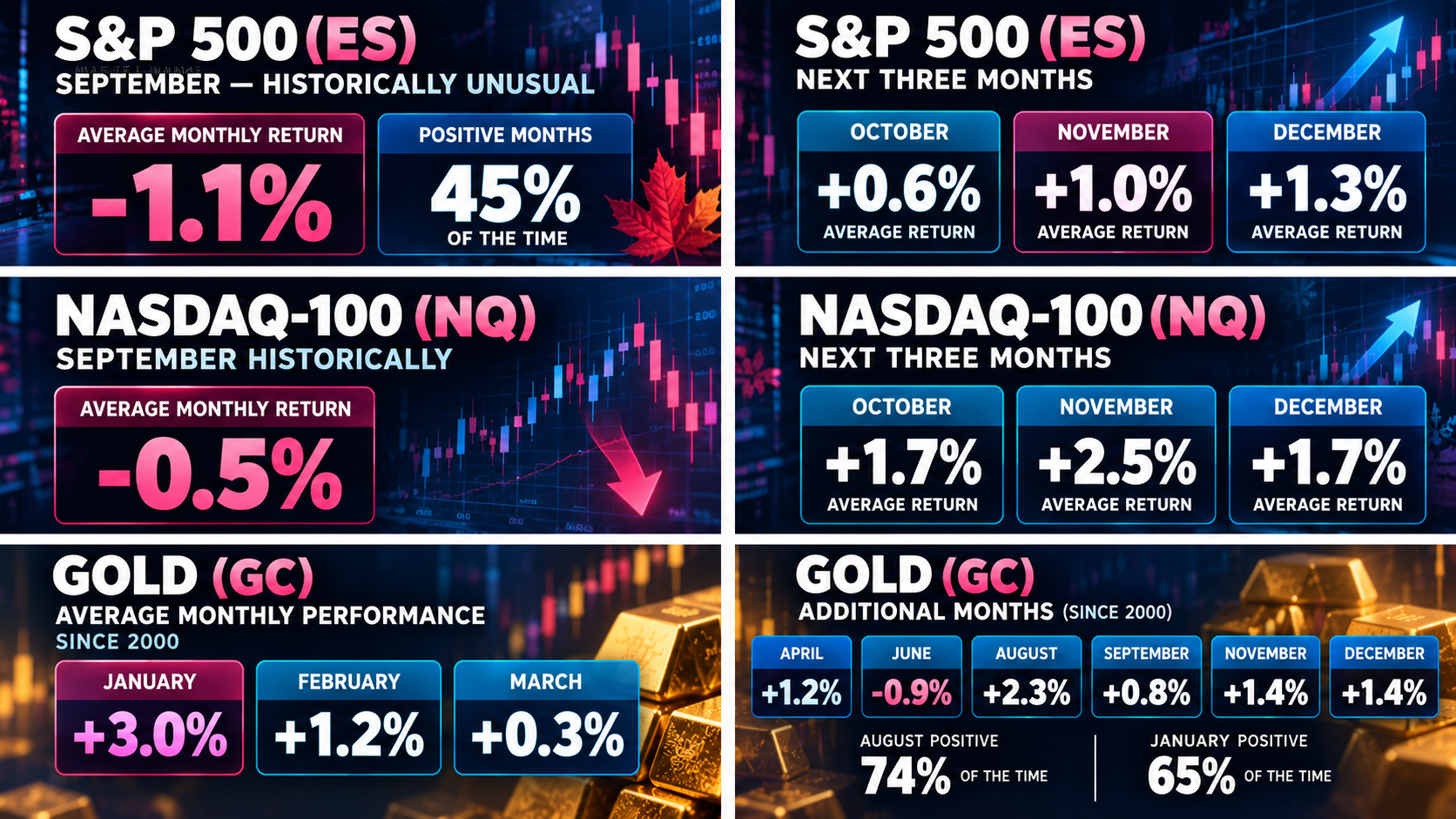
Some of the many stats I researched and offer up in this episode for all our futures traders out there. Yep, our markets do tend to have seasons that we can study and include as a factor when we create our trading biases based on data.
The Pruning Season
Eventually, most traders also encounter a season where something needs to go.
Maybe oversizing has crept back in. Maybe you're overtrading. Maybe revenge trading is costing you more than your strategy is making. Maybe a setup or management style that once worked for you no longer fits the trader you've become.
Pruning isn't failure. It's maintenance. A developing trader has to continually identify the behaviors that are no longer serving them and be willing to cut them out. This is what separates those that really can increase their winners from those that at best, stay stuck.
And Then There Are Winters
These are the hard seasons. You're in drawdown. Confidence is low. Nothing seems to be working. You start wondering whether you're ever going to figure trading out. Or whether all the work you've put in has mattered at all.
The danger is allowing a difficult season to become an identity. Your current trading season is not necessarily your permanent reality.
Winter may mean reducing size. Protecting capital. Taking a break. Returning to simulation. Studying your data. Rebuilding confidence through execution rather than forcing profitability. Sometimes growth is happening before you can see the evidence of it.
Context, Not Certainty
Studying seasonality reminded me of something I think traders need to hear more often: History gives us context. It does not give us certainty. September doesn't owe us a sell-off. December doesn't owe us a rally. Gold doesn't owe us a strong January.
And your own trading journey doesn't owe you profitability according to the timeline you imagined when you started. If you're harvesting right now, enjoy it and protect what's working. If you're planting, keep gathering evidence. If you're pruning, be willing to remove the behaviors holding you back. And if you're in winter, protect your risk and remember that you don't have to force a harvest from a season that is asking you to grow instead.
Markets change. Conditions change. Traders change too. No season lasts forever. The goal isn't to predict exactly when the next one will arrive. It's to keep preparing yourself so that when conditions change, you're ready to trade what the market actually gives you.
Want to Go Deeper Into the Data?
In the full episode, I dig further into the actual seasonality data behind ES, NQ, and gold (GC) including historical tendencies across fall, winter, spring, and summer, the Santa Claus rally, and some of the seasonal patterns that surprised me. We also look at why those historical tendencies can shift when you factor in earnings, interest rates, geopolitics, elections, supply and demand, and changing market participation.
If you want the numbers behind the conversation, and the bigger-picture context for the markets you trade, watch the full Market Mamas episode linked above. Just remember: seasonality is context, not a trading signal. Trade the market in front of you.
To those who show up for these conversations with me, the mental effort and time dedication, you are my people and I would love to get to know you better! Please take a moment to shoot me a comment on https://www.market-mamas.com/contact! Keep learning, keep growing, keep trusting yourself, and always show yourself some love throughout this pursuit. We got this!